Program Details
Inherent Requirement
Preparation for Becoming a Veterinarian
- Preparing Before Admission
- Is Veterinary Medicine the Right Path for You?
- Becoming a veterinarian is a rewarding career with significant impacts on animal health, human health, and food safety. However, studying and working in this profession requires multiple essential attributes, including:
- Ability to work effectively with others, including animal owners and interdisciplinary teams.
- Skills in learning, analyzing, and integrating complex knowledge.
- Commitment to continuous self-development in both academic knowledge and professional skills.
- Capacity to prioritize tasks, plan strategically, and make reasoned decisions.
- Resilience in adapting to rapidly changing situations and coping with long working hours.
- Flexibility, adaptability, and stress management skills.
- Applicants must meet the admission requirements announced for each admission program.
- Applicants must be in good physical health and free from diseases, conditions, or disabilities that would hinder their ability to study, practice, or enter the veterinary profession. These requirements are set out in the official announcement of the Deans’ Council of Faculties of Veterinary Medicine of Thailand (2016) Document link
- Should a student develop health impairments after admission, the program will consider the case individually, balancing the feasibility of achieving learning outcomes and minimum competencies with the safety of the student, animals, and others involved. Reasonable accommodations may include facilities such as elevators, ramps, or partial online learning. However, courses involving direct animal work will be reviewed and approved on a case-by-case basis by the program committee. Students may also explore credit transfer options if transferring to another faculty is necessary.
- Inherent Requirements of Veterinary Medicine
- Importance of Inherent Requirements
The DVM program aims to prepare students to become competent veterinarians through six years of academic and practical training. Students are expected to acquire knowledge in science and veterinary-specific fields, professional skills, and non-technical skills to practice effectively and safely in diverse contexts.
Students will train in a variety of environments, including classrooms, laboratories, animal hospitals, farms, abattoirs, and public health facilities, where they may be exposed to animals, animal waste, chemicals (e.g., disinfectants, formalin), and zoonotic agents. Therefore, students must be able to perform tasks safely for themselves, colleagues, animals, and animal owners.
Students are also required to understand and practice euthanasia appropriately, based on scientific principles and veterinary ethics. Professional attributes such as compassion, communication skills, teamwork, responsibility, ethical integrity, and cultural competence are essential.
Based on the curriculum framework and requirements of veterinary professional practice, inherent requirements are categorized into nine domains:
- Domain 1 – Legal and Regulatory Compliance
Students are required to understand and strictly comply with the regulations of the University and the Faculty, such as those governing the use of laboratories and participation in training. Adherence to these rules minimizes potential risks to themselves and others, and fosters readiness to become responsible professionals.
Upon graduation and entry into veterinary practice, graduates must also comply with all relevant veterinary laws and professional regulations.
Examples:
- Students comply with the Kasetsart University Undergraduate Study Regulations (link).
- Veterinarians comply with professional laws such as:
- Animal Epidemics Act, B.E. 2558 (2015) and its subordinate regulations
- Control of Animal Slaughter for the Distribution of Meat Act, B.E. 2535 (1992)
- Cruelty Prevention and Welfare of Animal Act, B.E. 2557 (2014) and its subordinate regulations
- Rabies Act, B.E. 2535 (1992)
- Veterinary Profession Act, B.E. 2545 (2002)
- Public Health Act, B.E. 2535 (1992)
- Animal Feed Control Act, B.E. 2558 (2015)
- Drug Act, B.E. 2510 (1967)
- Hazardous Substances Act, B.E. 2535 (1992)
- Domain 2 – Emotional and Behavioural Stability
Veterinarians are required to work in high-pressure and unpredictable situations, such as caring for critically ill animals, communicating with grieving animal owners, or collaborating with others under stressful and challenging conditions where opinions may differ. Emotional and behavioural stability is therefore essential to ensure appropriate responses, maintain composure, and uphold professionalism at all times.
Students must demonstrate the ability to manage their emotions, adapt to changing environments, and receive feedback from instructors or supervisors with a constructive attitude. They should also be mindful of their own physical and mental health, assess their readiness, and seek help when necessary—for example, when experiencing stress or workload beyond their capacity.
Veterinary practice is not only about academic knowledge or technical skills but also about the capacity to regulate emotions in real-life situations, work effectively with others, and sustain professional conduct. A lack of emotional and behavioural stability may compromise service quality, animal welfare, and the confidence of animal owners and professional colleagues.
Examples:
- Remaining composed and in control when faced with stressful or adverse situations.
- Accepting and applying constructive feedback for self-improvement.
- Seeking advice and assistance when needed.
- Adapting effectively to unexpected events or changes.
- Demonstrating calm, courteous, and professional behaviour in all situations.
- Domain 3 – Ethics and Professional Responsibility
Veterinary medicine is a profession that must operate under strict professional ethical standards. Accordingly, students in the Doctor of Veterinary Medicine program are expected to demonstrate knowledge, understanding, and adherence to professional ethics, as well as behaviours that align with the standards and expectations of the veterinary profession.
Compliance with ethical principles and relevant policies not only fosters positive relationships among students, faculty, staff, clients, and the general public but also directly safeguards animal welfare and safety. Students must work with accuracy, transparency, and respect for others, while also handling confidential information with discretion. Ethical decision-making is required when facing complex or conflicting situations, such as providing care for animals when owners face financial limitations, or when encountering animal welfare concerns.
Veterinarians are entrusted with the responsibility of safeguarding animal lives, communicating with people, and making decisions with ethical implications. Therefore, demonstrating ethical conduct and professional responsibility is crucial to building public trust in the veterinary profession, ultimately benefiting both society and the animals under care.
Examples:
- Maintaining a record free from disciplinary or academic misconduct.
- Respecting and protecting the confidentiality of clinical and client information.
- Applying ethical principles in complex decision-making, such as balancing animal welfare with the financial constraints of animal owners.
The Doctor of Veterinary Medicine (DVM) program emphasizes the development of effective communication skills in verbal, non-verbal, and written forms. Communication may occur in one-to-one or multi-directional contexts, including interactions between humans, or between humans and animals. Strong communication skills are essential to ensure smooth, efficient, and safe learning, clinical training, and animal care.
Verbal Communication
Clear and context-appropriate verbal communication in Thai is crucial for the safety of students, colleagues, and animals, particularly in urgent situations that require immediate animal restraint or behavioural management. Students must be able to understand and respond to verbal communication accurately, appropriately, and promptly, even in noisy environments. They must also be able to give clear instructions in situations requiring safe and effective handling.
Examples:
- Participating in teaching activities, simulations, and clinical discussions.
- Responding appropriately to requests or instructions during clinical practice.
Non-verbal Communication
Non-verbal cues, such as facial expressions, tone of voice, eye contact, gestures, and body movements, are integral components of communication. Students must be able to perceive, interpret, and respond appropriately to behavioural signals from both humans and animals. They should demonstrate confidence in their non-verbal communication while maintaining awareness of their own behaviour in educational and professional contexts. This ability not only enhances relationships with clients and faculty but is also critical in observing animal signs, diagnosing conditions, and ensuring safe animal handling.
Examples:
- Recognizing and responding appropriately to classroom interactions.
- Interpreting and responding to animal behavioural signals in clinical contexts.
Written Communication
Written communication, particularly in Thai, is a vital professional skill for veterinarians. It includes record-keeping, report writing, and written communication with animal owners. Students must be able to write systematically, clearly, and appropriately for the context, while accurately conveying academic and clinical information according to professional standards. Effective written communication supports accurate clinical practice, verifiability, and efficient information transfer.
Examples:
- Preparing accurate and timely veterinary records in compliance with professional standards.
- Writing clear and academically accurate instructions or documents for animal owners.
- Domain 5 – Knowledge and Cognition
Veterinary students must possess a deep understanding of knowledge and be able to apply it appropriately and effectively within professional contexts. This attribute forms the foundation for safety, quality of animal care, and effective communication with animal owners and colleagues.
This domain can be described in three key areas:
1. Knowledge and Application
Students must be able to acquire knowledge from multiple sources, including classroom learning, field experiences, and self-directed study. They are expected to analyze, synthesize, and apply this knowledge in clinical practice appropriately. The ability to connect theoretical knowledge with real-world application—such as planning treatment for sick animals—demonstrates the student’s capacity to evaluate information, assess risks, and make timely decisions. A lack of these skills could result in unsafe or incorrect treatment.
Examples:
- Applying knowledge of pathophysiology to analyze the causes of abnormal symptoms in animals.
- Using information from scientific literature to compare treatment options and select the most appropriate approach.
2. English Language Proficiency
Students must be able to receive, interpret, speak, read, and write in English at a level appropriate for veterinary learning and practice. Since the majority of global knowledge—including standard guidelines and scientific journals—is in English, veterinarians must continuously update their knowledge from international sources. English proficiency is also essential for collaboration with international veterinarians, researchers, and organizations.
Examples:
- Reading scientific articles in English and summarizing key content for class discussion.
- Writing clinical case reports using professional veterinary English.
3. Numeracy and Applied Mathematics
Accurate use of numerical skills is essential in veterinary practice. Calculations are central to many professional tasks, such as determining drug dosages, planning fluid therapy, and interpreting quantitative data from medical records or laboratory reports. Errors in calculation, such as incorrect drug dosages, can have serious consequences for animal health. Therefore, numeracy is a critical foundation of safe and effective veterinary practice.
Examples:
- Calculating drug dosages for individual animals based on body weight and drug concentration.
- Analyzing blood test results to decide on fluid therapy or treatment adjustments.
- Formulating specialized diets for animals with nutritional disorders.
- Domain 6 – Sensory Abilities
Health and sensory abilities required for students in the Doctor of Veterinary Medicine (DVM) program are defined by the announcement of the Deans’ Council of Faculties of Veterinary Medicine of Thailand on the Specific Qualifications of Applicants for the DVM Program (2016).
Applicants with impairments in vision, hearing, or tactile sense are encouraged to consult experts prior to applying, to ensure that they have sufficient ability to study and practice veterinary medicine. If such impairments develop during the course of study, the Faculty and University will conduct a comprehensive assessment of the impact on learning, in collaboration with the student and their family, to identify appropriate adjustments or support. However, if the impairment significantly hinders performance in ways that cannot be reasonably accommodated, students may be advised to transfer to another program more suitable to their abilities.
1. Vision
Vision is a critical requirement for veterinary learning and practice. Students must possess sufficient visual acuity to clearly perceive images necessary for examination, diagnosis, and detailed clinical tasks. Visual acuity in the better eye, when corrected with glasses, must not be less than 6/12 (20/40), in accordance with the Deans’ Council announcement.
Examples:
- Accurately preparing and dispensing medications.
- Observing subtle animal responses to treatment, such as minor changes in posture or behaviour.
- Reading fine print on medicine vials.
- Performing microscopic diagnostic examinations.
2. Hearing
Hearing plays an essential role in both diagnosis and communication in veterinary environments. Students must have adequate hearing ability in both ears so as not to impede their learning or practice, in line with the Deans’ Council announcement.
Examples:
- Auscultating heart and lung sounds to detect abnormalities.
- Listening to sounds from diagnostic instruments, such as blood pressure monitors.
- Responding promptly to alarms or team signals in emergency situations.
3. Tactile Sense
Tactile ability is essential for physical examination and diagnosis in veterinary practice. Students must be able to palpate, hold, or physically assess animals to detect abnormalities. Adequate tactile sense ensures competence in tasks requiring manual sensitivity and precision.
Examples:
- Palpating abdominal organs to assess their condition.
- Detecting abnormalities in lymph nodes, muscles, or joints.
- Assessing neurological responses in animals through tactile examination.
- Domain 7 – Physical Strength and Mobility
The study and practice of veterinary medicine require students to maintain sufficient physical strength and mobility, encompassing both gross motor skills and fine motor skills, to perform tasks safely and effectively while minimizing the risk of injury to themselves, others, and animals.
1. Gross Motor Skills
Students must demonstrate basic physical abilities such as lifting, carrying, pushing, pulling, standing, walking, running, bending, and twisting, as well as the capacity to restrain animals. These abilities are essential for tasks that require sustained physical effort and coordination. Veterinary practice often involves working with large animals such as cattle, horses, and dogs, and in variable environments such as farms, uneven terrains, or confined clinical spaces. Without sufficient gross motor skills, students may not be able to safely restrain animals or perform essential tasks.
Examples:
- Safely lifting or moving animals or objects weighing up to 20 kilograms.
- Restraining animals such as cattle, horses, or dogs.
- Performing obstetrical procedures, such as assisting in calving.
- Quickly exiting enclosures for safety.
2. Fine Motor Skills
Students must also possess the ability to use their hands and fingers with precision for tasks requiring dexterity, such as grasping, squeezing, pressing, rotating, or manipulating small instruments. Fine motor control is essential for managing small animals and performing delicate veterinary procedures. Tasks such as catheterization, blood collection, and surgery require hand–eye coordination and precision to ensure effective treatment and minimize risks to animals and practitioners.
Examples:
- Using diagnostic instruments accurately.
- Performing procedures such as catheter placement or blood sampling.
- Safely and gently handling small animals such as mice, guinea pigs, or birds.
- Conducting surgical procedures, such as canine sterilization.
- Domain 8 – Health and Performance
The study and practice of veterinary medicine require students to maintain both physical strength and psychological stability at a sustainable level. Veterinary training involves not only theoretical learning but also extensive practical training that often demands significant physical energy, sustained concentration, and emotional regulation over extended periods of time.
Examples of such tasks include performing surgical procedures, caring for animals in emergency situations, and managing complex diagnoses and treatments. The ability to maintain health and performance consistently is therefore essential to ensure that students can carry out their responsibilities safely and effectively.
Examples:
- Performing lengthy procedures, such as repositioning a newborn animal during delivery.
- Managing multiple tasks simultaneously, such as monitoring animal conditions while recording clinical data.
- Domain 9 – Diversity, Equity and Inclusion (DEI)
The Faculty of Veterinary Medicine, Kasetsart University, is committed to promoting diversity, equity, and inclusion (DEI) at all levels of education and professional practice. The Faculty strives to create an environment that respects differences, embraces all identities, and supports effective collaborative learning.
All students are expected to respect diversity and demonstrate an understanding of DEI principles throughout their studies—whether in classrooms, clinical training sites, or faculty activities. Students are encouraged to grow into veterinarians who are mindful of fairness, inclusivity, and equity when entering the profession.
The Faculty requires all units to uphold DEI principles by:
- Promoting learning, dialogue, and understanding of diversity, equity, and inclusion, while ensuring equal support for all students.
- Ensuring inclusivity across all undergraduate and graduate programs by creating environments that foster optimal research, education, and professional work.
- Respecting rights and gender identity, including the freedom to dress in accordance with one’s gender identity, provided it is appropriate to the context.
- Providing training to raise awareness and sensitivity among faculty, staff, and students regarding DEI issues.
- Organizing other activities that promote diversity, equity, and inclusion within the Faculty.
If any faculty member or student has concerns or questions related to diversity, equity, and inclusion, they may contact the Associate Dean for Student Affairs or file a confidential report through the ISO complaint system.
- Support and Consultation
- For further inquiries or consultation, please contact the Educational Services Unit (Bangkhen Campus):
- Address: Faculty of Veterinary Medicine, Kasetsart University (Bangkhen Campus)
Mezzanine Floor, Lecture and Laboratory Building
50 Ngamwongwan Road, Lat Yao, Chatuchak, Bangkok 10900, Thailand
- Telephone: +66 (0) 2797-1900 ext. 4101–4103
Career Guidance and Opportunities
Knowledge Assessment and Professional Licensing
Students are required to pass the basic competency assessment in their 5th year in order to be eligible to apply for a veterinary professional license in Thailand. This assessment is in accordance with the Veterinary Council Regulation B.E. 2562 (2019) on the criteria, procedures, and conditions for registration, issuance, and renewal of veterinary licenses (further details available on the Veterinary Council website).
The examination is divided into three categories:
- Category 1: General competency in veterinary professional practice and professional identity
- Category 2: Academic knowledge and understanding in veterinary science
- Category 3: Practical skills and competencies
Candidates must first pass Category 1 before being eligible to take Categories 2 and 3. The assessment for Category 1 is administered by the Faculty of Veterinary Medicine at each institution, and the assessment methods may vary depending on the agreement with the central assessment center.
Upon graduation and successful completion of all three categories, students will be awarded the Doctor of Veterinary Medicine (DVM) degree and may apply for registration to practice veterinary medicine in Thailand under the law.
Career Pathways for Veterinarians
Veterinarians can pursue careers across diverse sectors, including government, private organizations, international agencies, and advanced studies. Common career pathways include:
- Veterinary practitioner in animal clinics or hospitals
- Farm veterinarian in livestock production
- Large animal veterinarian (e.g., cattle, swine, horses, goats, sheep)
- University lecturer or academic staff
- Researcher in animal health sciences, biotechnology, or related fields
- Diagnostic laboratory scientist
- Public Sector and Public Health
- Government officer or academic expert in agencies such as: Department of Livestock Development, Department of Fisheries, Department of National Parks, Ministry of Public Health, Ministry of Interior, or Ministry of Defence
- Wildlife and Aquatic Animal Health
- Employment in zoos, wildlife conservation centers, or breeding stations
- Aquatic animal health services in aquaculture farms, aquariums, or conservation organizations
- International Organizations
- Engagement with international bodies such as FAO (Food and Agriculture Organization of the United Nations) and WOAH (World Organisation for Animal Health)
- Work in international development projects or veterinary-related NGOs
- Veterinary Industry and Business
- Technical specialist or sales representative in veterinary pharmaceutical, feed, or animal health product companies
- Roles in quality assurance, research and development, or production lines
- Entrepreneurship in veterinary health services or distribution of veterinary products
- Veterinary media and communications (e.g., writing, translation, publishing in veterinary-related fields)
- Business consultant or expert in veterinary clinic and hospital management
- Postgraduate degrees (Master’s or PhD) in fields such as animal science, animal health, public health, or biotechnology
- Board certification in a veterinary specialty of interest
- Graduate diploma or residency programs as preparation for specialist qualifications
Rabies Vaccination
For the safety of students during practical training, where there may be risks of animal exposure or working in rabies-endemic areas, the Faculty of Veterinary Medicine provides rabies vaccination annually at no cost.
First-year students:
- Will receive a pre-exposure vaccination in the first semester.
Second-year students and above:
- Will receive a booster dose in the first semester or according to the recommended interval.
If students have previously received rabies vaccination from another institution or organization, they are required to submit official vaccination records for verification. Additional vaccination will not be necessary if their immunity is still valid.
Estimated Basic Expenses and Tuition Fees
Faculty of Veterinary Medicine, Kasetsart University
|
Item
|
Estimated Amount
|
Remarks
|
|
Tuition Fee
|
30,300 THB / semester
|
See details
|
|
University Dormitory Fee
|
2,000 – 2,300 THB / person / semester (approx. 4 months)
|
See details
|
|
Clinical Learning Equipment
|
5,000 – 10,000 THB
|
Depending on the student’s choice of equipment
|
|
Placement Expenses
|
Supported by the Student Development Fund, up to 2,000 THB per year
|
See details
|
Note: The above information represents estimated expenses and is subject to change depending on university policies and the student’s individual choices.
Scholarships for Students
The Faculty of Veterinary Medicine places strong emphasis on supporting students in all dimensions — academic development, life skills, and well-being — through the management of the Student Development Fund, which was established to provide opportunities for students to grow holistically.
Objectives of the Fund
- Support educational expenses
- Promote professional learning, skills development, and life skills
- Support academic, cultural, and volunteer activities
- Enhance special talents, language skills, and career readiness
- Promote students’ physical and mental well-being
Types of Scholarships Available
- Educational Support Scholarships – for financially disadvantaged students
- Merit Scholarships – for students with outstanding academic performance
- Work-Study Scholarships – for students assisting with faculty duties
- Emergency Scholarships – in urgent circumstances such as the death of a parent
- Academic Support Scholarships – e.g., for research or academic conference participation
- Achievement Scholarships – for students who win national or international awards
- Overseas Study Support Scholarships – for academic exchange programs abroad
- Student Activity Support Scholarships – for activities aligned with the Fund’s objectives
- Placement Support Scholarships – to subsidize pleacment travel expenses
Eligibility
All students of the Faculty of Veterinary Medicine, across all years of study, who meet the specific criteria of each scholarship type are eligible to apply.
For further details, please click here to view the full criteria
Placement in the Doctor of Veterinary Medicine (DVM) Program
The Faculty of Veterinary Medicine requires placement training as an essential part of the curriculum to ensure that students gain real-world experience, develop both academic and professional competencies, and prepare to become high-quality veterinarians who meet international standards.
- What is WIL and Types of WIL
Work-Integrated Learning (WIL) refers to “learning through real work experience.” It is an experiential learning process that integrates academic knowledge from the classroom with hands-on training in professional workplaces such as clinics, veterinary hospitals, farms, or relevant organizations, under close supervision and mentorship from experts.
- Objectives
- Prepare students to develop professional skills and career readiness before entering the workforce.
- Integrate theoretical knowledge with practical applications in standardized workplaces.
- Provide opportunities to experience the diversity of veterinary practice, work environments, service levels, and career pathways.
- Develop teamwork, problem-solving, and effective communication skills.
- Types of WIL
- WIL is divided into four main categories:
|
Type
|
Description
|
|
Animal Husbandry Placement
|
Training in animal-related workplaces (e.g., farms or shelters) under the supervision of farm managers or animal caretakers to learn animal management, husbandry, and owner communication.
|
|
Preclinical Placement
|
Training in veterinary facilities under the supervision of veterinary teams, familiarizing students with facility operations and basic skills such as animal restraint and primary care.
|
|
Clinical Placement
|
Practical training in veterinary hospitals under supervision of veterinarians, where students participate formally in patient diagnosis and treatment.
|
|
Professional (Non-Clinical) Placement
|
Experience in veterinary-related organizations not directly involving clinical care, such as government agencies, veterinary businesses, diagnostic laboratories, or animal welfare organizations. (Can be counted as clinical placement if supervised by veterinarians.)
|
- Requirements and Placement Hours
Students must complete at least 52 weeks of placement throughout the program, divided by level as follows:
Students must complete at least 12 weeks, consisting of three main forms:
|
Type
|
Minimum Duration
|
Details
|
|
Animal Husbandry Placement
|
≥ 6 weeks
|
- Hands-on training in animal care and management covering three main groups: Production animals (cattle, buffalo, goats, sheep / swine / poultry), Equine (horses), and Companion animals (dogs, cats, exotic pets).
|
|
Pre-clinical Placement
|
≥ 2 weeks
|
Workplace training under veterinary supervision.
|
|
Faculty-based training
|
≥ 30 hours/year
|
Training at the Kasetsart University Animal Hospital (Bang Khen Campus).
|
Students must complete at least 40 weeks, divided into:
|
Type
|
Minimum Duration
|
Details
|
|
VEE-controlled (Clinical Practice)
|
24 weeks
|
Enrolled in Clinical Practice courses according to the study plan under supervision of faculty veterinarians (during semester).
|
|
Extramural Placement
|
≥ 12 weeks
|
Placement in areas of student interest such as private clinics, farms, or public health agencies (Clinical or Professional placement), under veterinary supervision.
|
|
Faculty-based training
|
≥ 1 week
|
Optional training at university animal hospitals (Bang Khen, Kamphaeng Saen, Nong Pho, Hua Hin, Thippiman) or at the Animal Diagnostic Center.
|
- Financial Support
The Faculty provides financial support for travel expenses when students undertake placements at external organizations, based on distance:
|
Distance from University
|
Maximum Allowance
|
|
≤ 500 km
|
1,000 THB
|
|
> 500 km
|
2,000 THB
|
Note: Eligible for reimbursement once per academic year, calculated from the farthest training site attended that year.
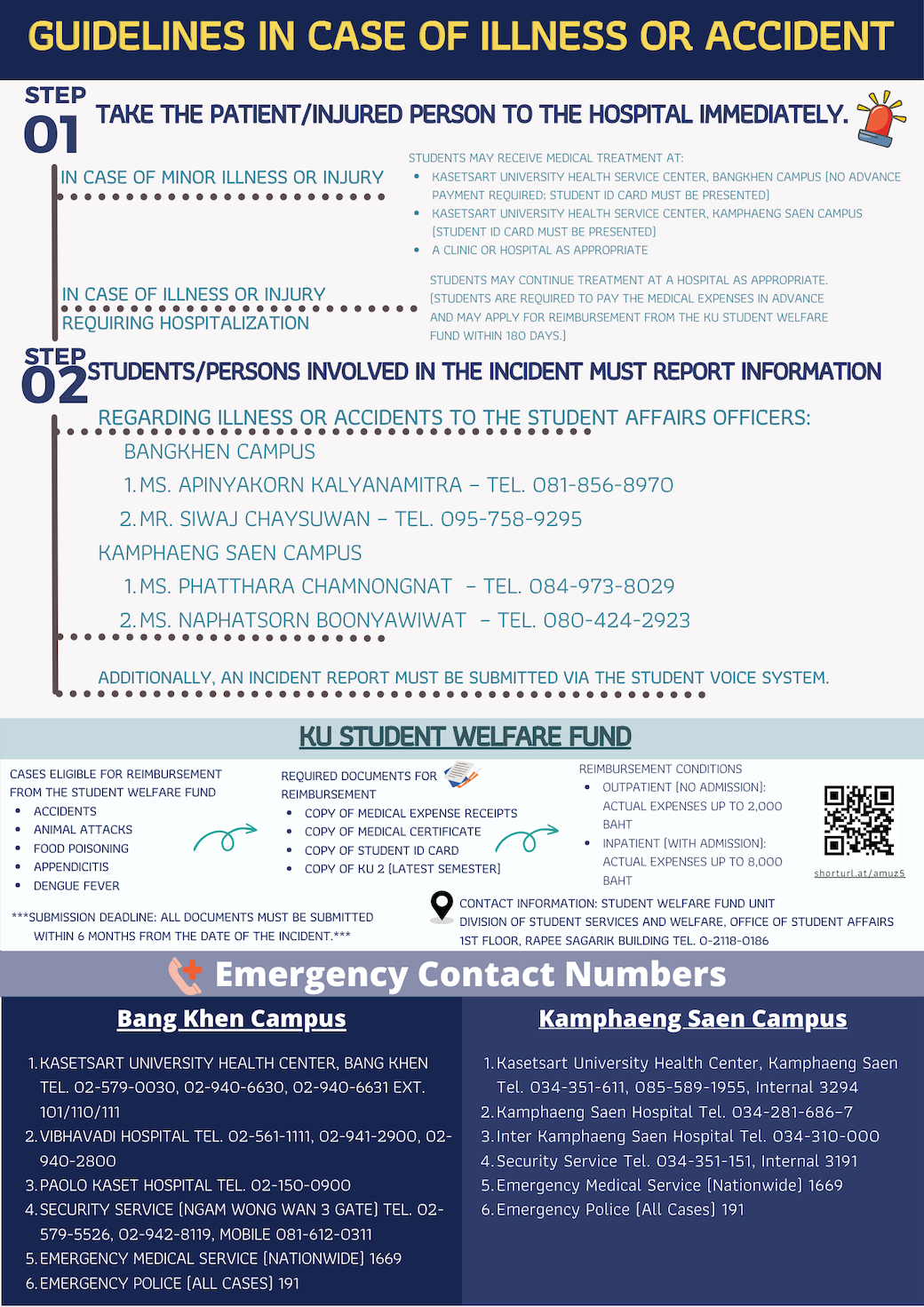
- Accident Insurance
- All students are covered by accident insurance provided annually by Kasetsart University under defined conditions and coverage limits.
- In case of accidents or illness during placement, students may claim healthcare coverage under the National Health Security Scheme (Gold Card/other entitlements) and/or University accident insurance.
- Students or their contacts must promptly notify the Office of Educational Services Unit, Faculty of Veterinary Medicine, to ensure support, coordination, and insurance claim processing.
- Additional details on accident insurance can be found on the website of the Kasetsart University Division of Student Affairs.
Additional Placement Guidelines
Facilities
The Faculty of Veterinary Medicine, Kasetsart University, provides comprehensive facilities to support both theoretical and practical teaching and learning. These facilities include lecture rooms, laboratories, clinical skills laboratories, veterinary teaching hospitals, teaching farms, and animal disease diagnostic centers. Together, they enable students to learn through real-life experiences and practice in environments closely resembling professional veterinary settings.
Bangkhen Campus
- Lecture rooms
- Laboratories
- Clinical Skills Laboratory
- Kasetsart University Veterinary Teaching Hospital, Bangkhen – supporting clinical teaching in companion animals, with access to real patients to enhance students’ practical experience
- Kasetsart University Veterinary Diagnostic Laboratory, Bangkhen
Kamphaeng Saen Campus
Other Veterinary Teaching Hospitals
Facilities VET KU MAP